Navigating the transformative journey of adolescence can be one of the most rewarding yet challenging experiences for any family. This comprehensive parenting teenagers guide is designed to equip parents with actionable strategies, profound insights into adolescent psychology, and practical advice to foster a nurturing environment where teenagers can thrive, ultimately strengthening family well-being and upholding mutual rights.
Raising a teenager involves understanding their rapidly evolving world, from brain development to social pressures, and adapting your parenting approach to support their growth into responsible, well-adjusted adults. By focusing on connection, clear communication, and consistent boundaries, parents can help their teens build resilience, confidence, and strong decision-making skills. This guide provides a foundational overview, inviting you to delve deeper into specific topics that are crucial for successful adolescent guidance.
Quick Reference: Pillars of Effective Adolescent Guidance
| Key Aspect | Why It Matters for Family Well-being | Practical Application |
|---|---|---|
| Understanding Adolescent Development | Informs realistic expectations and fosters empathy for teenage behaviors. | Educate yourself on brain changes, social needs, and emotional surges. |
| Effective Communication | Builds trust, strengthens bonds, and facilitates conflict resolution. | Practice active listening, use ‘I’ statements, and schedule regular check-ins. |
| Setting Healthy Boundaries | Provides structure, safety, and teaches self-discipline. | Establish clear rules with natural consequences, involve teens in decision-making where appropriate. |
| Fostering Independence | Cultivates self-reliance, responsibility, and confidence. | Offer choices, delegate responsibilities, and allow them to learn from mistakes. |
| Navigating Challenges | Equips teens with coping mechanisms and ethical decision-making skills. | Discuss peer pressure, digital citizenship, and healthy risk assessment openly. |
| Promoting Mental Health | Safeguards emotional well-being and reduces stigma. | Create a supportive environment, encourage self-care, and know when to seek professional help. |
| Avoiding Common Mistakes | Prevents avoidable conflicts and strengthens the parent-teen relationship. | Reflect on your own biases, avoid comparisons, and prioritize connection over control. |
| Building a Resilient Family | Ensures long-term stability, support, and adaptability through life’s changes. | Maintain family traditions, promote mutual respect, and value individual contributions. |
Understanding Adolescent Development: The Teenage Brain and Beyond
Embarking on the journey of guiding adolescents requires a foundational understanding of the profound developmental shifts occurring within them. This section is a crucial part of any effective adolescent guidance for parents, as it illuminates the biological and psychological transformations that shape teenage behavior, emotions, and decision-making. Recognizing these changes empowers parents to respond with empathy and informed strategies, thereby strengthening family well-being and mutual respect. We delve into the science behind the teenage brain and the broader aspects of identity formation that define this critical stage.
How Does Adolescent Brain Development Impact Behavior?
During adolescence, the brain undergoes significant remodeling, profoundly impacting a teenager’s cognitive abilities, emotional responses, and social interactions. Key areas like the prefrontal cortex, responsible for executive functions such as planning, judgment, and impulse control, are still rapidly maturing. Concurrently, the amygdala, the brain’s emotional center, is highly active, leading to intensified emotional reactions and a heightened sensitivity to social cues. This interplay between an immature prefrontal cortex and a highly reactive amygdala can result in behaviors often perceived as impulsive, moody, or risk-prone. Hormonal surges further complicate these neurological shifts, contributing to mood swings and a heightened drive for novelty and social connection. Understanding these biological underpinnings allows parents to frame challenging behaviors not as deliberate defiance, but often as a result of an evolving brain. For an in-depth exploration of brain development, refer to our comprehensive guide on Adolescent Brain Development [CLUSTER LINK: Adolescent Brain Development].
Effective Communication Strategies for Parents and Teenagers
Armed with an understanding of the teenage brain, the next crucial step in effective teen parenting is mastering communication, which forms the bedrock of strong family relationships and mutual respect. This section provides vital strategies for fostering an environment where open dialogue thrives, ensuring that parents and teenagers can express themselves honestly and feel heard. Building this communicative bridge is essential for enhancing overall family well-being and ensuring that a teenager’s voice is valued within the family unit.
Active Listening and Empathetic Responses
Effective communication begins not with talking, but with listening. Active listening involves giving your teenager your full attention, truly hearing their words, and understanding the emotions behind them. This means putting away devices, making eye contact, and reflecting back what you’ve heard to ensure clarity (“So, if I understand correctly, you’re feeling frustrated because…”). Empathetic responses validate their feelings, even if you don’t agree with their perspective. Phrases like “That sounds really tough” or “I can see why you’d feel that way” can create a safe space for them to open up further. Consistency is key; aim for at least 15 minutes of uninterrupted, device-free conversation daily, perhaps during a meal or a car ride. Such consistent, non-judgmental interactions build trust over time.
- Key Communication Principles:
- Be Present: Minimize distractions and give your full attention.
- Listen More, Talk Less: Focus on understanding their perspective.
- Validate Feelings: Acknowledge their emotions without necessarily agreeing with their actions.
- Use “I” Statements: Express your feelings and needs without blaming. (“I feel concerned when you come home late” instead of “You always come home late.”)
- Choose Your Moments: Address sensitive topics when both parties are calm and have time.
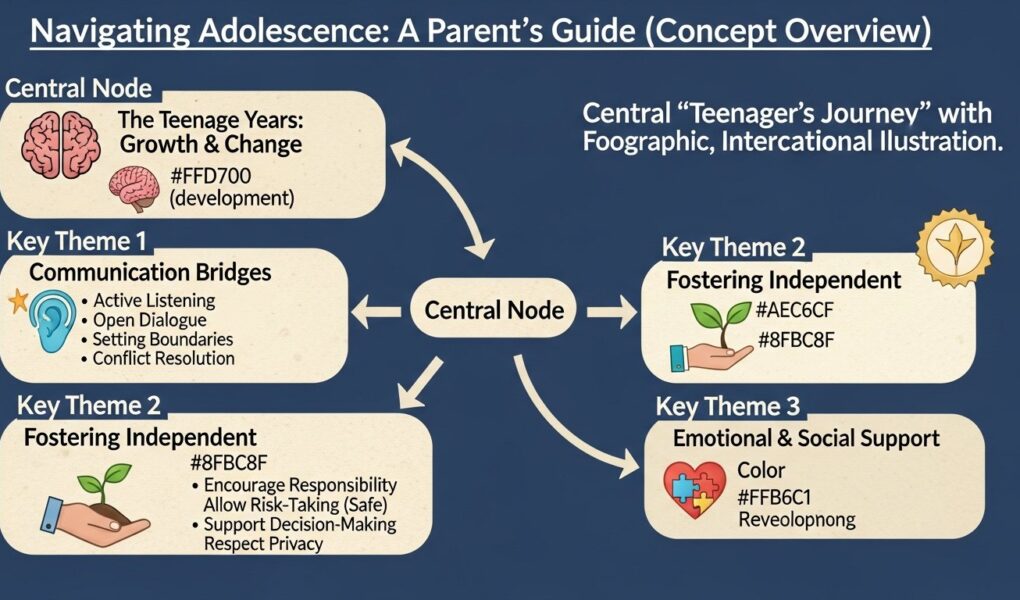
[INLINE IMAGE 1: diagram illustrating key areas of adolescent brain development and their functions]
Setting Healthy Boundaries and Expectations
A cornerstone of any effective parenting teenagers guide involves establishing clear and healthy boundaries. This section explores how consistent expectations and respectful limits empower teenagers while safeguarding the entire family’s well-being. Boundaries are not about control; they are about providing structure, predictability, and a sense of security, which are vital for adolescent development and for defining individual rights and responsibilities within the family.
What Are Age-Appropriate Boundaries for Teenagers?
Age-appropriate boundaries evolve as teenagers mature, balancing their increasing need for autonomy with the ongoing need for guidance and protection. Initially, boundaries might be very structured, focusing on safety (e.g., curfews, digital device usage limits, clear rules about substance use). As teenagers demonstrate greater responsibility, these boundaries can become more flexible and negotiable. The key is involving teenagers in the discussion of rules and consequences whenever possible. This fosters a sense of ownership and demonstrates respect for their developing judgment. For example, rather than simply stating a curfew, discuss why it exists (safety, sleep, family time) and explore what a reasonable time might be for their age and activity. Consistent enforcement, coupled with logical and natural consequences, teaches responsibility far more effectively than punishment alone. What success looks like: Your teenager initiates conversations about boundaries, actively participates in finding solutions, and respects agreed-upon limits, indicating strong internal self-regulation over time. What failure looks like: Frequent arguments over rules, a pattern of breaking boundaries without remorse, or a refusal to engage in discussions, suggesting a breakdown in trust and understanding. For an in-depth exploration of boundary setting, refer to our comprehensive guide on Healthy Boundaries [CLUSTER LINK: Healthy Boundaries].
Fostering Independence and Responsibility in Adolescents
Empowering teenagers to develop independence and responsibility is a core objective of effective teen parenting. This section delves into strategies that help young people build self-reliance, make sound decisions, and learn from their experiences. By providing opportunities for autonomy within a supportive framework, parents contribute significantly to their teenager’s personal growth and enhance their capacity to contribute positively to their family and community, thereby promoting overall family well-being and individual rights.
Empowering Autonomy and Self-Reliance
Fostering independence means gradually transferring control to your teenager while still providing a safety net. This involves allowing them to make more of their own choices, even if those choices lead to small, manageable mistakes. Provide them with opportunities to manage their own schedules, finances (e.g., a budget for clothes or outings), and academic responsibilities. Delegate household chores and tasks that require planning and follow-through, such as meal preparation or managing family errands. Encourage them to problem-solve independently before jumping in to “fix” things. You might say, “That sounds like a tricky situation; what are some options you’ve thought about?” This approach builds their confidence and teaches them to trust their own judgment. Observe if your teenager consistently takes initiative on their responsibilities without prompting, indicating increased self-reliance. For an in-depth exploration of fostering independence, refer to our comprehensive guide on Fostering Independence [CLUSTER LINK: Fostering Independence].
[INLINE IMAGE 2: infographic demonstrating the positive feedback loop between parental support and teenage independence]
Navigating Common Teenage Challenges
The adolescent years are a period marked by unique and sometimes daunting challenges. This section of our adolescent guidance for parents addresses common hurdles teenagers face, from peer pressure to digital dilemmas, offering parents strategies to help their teens navigate these complexities successfully. By proactively discussing and preparing for these issues, parents can safeguard their teenager’s well-being and reinforce a sense of family unity and support.
Addressing Peer Influence and Digital Citizenship
Peer influence, both positive and negative, plays a significant role in a teenager’s life. Rather than attempting to shield them entirely, which is often impossible, parents can equip teenagers with the tools to discern healthy friendships from unhealthy ones and to confidently stand up for their values. Encourage open conversations about peer dynamics, asking questions like, “What qualities do you look for in a friend?” and “What would you do if a friend suggested something you weren’t comfortable with?”
Equally complex is the realm of digital citizenship. Teenagers today grow up immersed in online environments, facing issues such as cyberbullying, privacy concerns, and the pressures of social media. Establishing clear family guidelines for device usage, screen time, and online behavior is crucial. Engage in discussions about online safety, digital footprints, and responsible sharing. Review privacy settings together, and emphasize the importance of kindness and respect in all online interactions. For an in-depth exploration of these challenges, refer to our comprehensive guide on Teenage Challenges [CLUSTER LINK: Teenage Challenges].
Promoting Emotional Well-being and Mental Health
The emotional landscape of adolescence can be turbulent, making the promotion of mental health a paramount concern for parents. This section provides insights and strategies for protecting and nurturing a teenager’s emotional well-being, fostering resilience, and knowing when to seek professional support. A focus on mental health is integral to supporting adolescent development and ensuring every family member’s rights to safety and support are met.
How Can Parents Support Their Teenager’s Mental Health?
Supporting a teenager’s mental health involves creating an environment of psychological safety where they feel comfortable expressing their struggles without fear of judgment. Encourage open dialogue about feelings, stress, and anxieties. Teach and model healthy coping mechanisms, such as mindfulness, exercise, creative outlets, or spending time in nature. Ensure they get adequate sleep and nutrition, as these are foundational to emotional stability. It’s also vital to monitor for signs of mental health struggles, such as persistent sadness, withdrawal from friends or activities, significant changes in appetite or sleep patterns, irritability, or self-harm. Track a decrease in household conflicts over a three-month period after implementing consistent emotional check-ins, which can indicate improved emotional regulation and family dynamics. If concerns arise, do not hesitate to seek professional help from a therapist, counselor, or pediatrician. Early intervention can make a significant difference. For an in-depth exploration of mental health support, refer to our comprehensive guide on Mental Health Support [CLUSTER LINK: Mental Health Support].
- Signs Your Teenager Might Need Professional Support:
- Persistent sadness or irritability lasting more than two weeks.
- Loss of interest in activities they once enjoyed.
- Significant changes in sleep patterns or appetite.
- Withdrawal from friends, family, or social situations.
- Decline in academic performance.
- Expressions of hopelessness, self-harm, or suicidal thoughts.
- Increased risky behaviors.
Common Parenting Mistakes to Avoid with Teenagers
Even with the best intentions, parents can sometimes fall into patterns that inadvertently create distance or exacerbate challenges during the teenage years. This section of our effective teen parenting guide highlights common pitfalls to avoid and offers alternative, more constructive approaches. Recognizing and correcting these mistakes can significantly improve family dynamics and strengthen your relationship with your teenager.
- Over-controlling vs. Offering Autonomy: Trying to dictate every aspect of a teenager’s life stifles their growth and can lead to rebellion. Instead, offer choices within safe parameters and gradually increase their decision-making power.
- Dismissing Feelings vs. Validating Emotions: Saying “It’s not a big deal” or “You’re overreacting” invalidates their experience and shuts down communication. Instead, acknowledge their feelings (“That sounds really frustrating”) before offering guidance.
- Comparing to Peers or Siblings vs. Celebrating Individuality: Comparisons breed resentment and diminish self-esteem. Focus on your teenager’s unique strengths and progress, celebrating their individual journey.
- Inconsistent Discipline vs. Clear, Consistent Consequences: Shifting rules or unpredictable consequences create confusion and undermine authority. Establish clear boundaries and apply consequences consistently and fairly.
- Lack of Boundaries vs. Respectful Limits: Providing no structure or limits can leave teenagers feeling insecure and overwhelmed by freedom. Healthy boundaries provide a sense of security and teach self-control.
- Expecting Perfection vs. Encouraging Growth: Pressuring teenagers for flawless performance can lead to anxiety and fear of failure. Emphasize effort, resilience, and learning from mistakes.
- Passive Communication vs. Open Dialogue: Avoiding difficult conversations or waiting for your teen to initiate everything leaves important topics unaddressed. Proactively create opportunities for open, honest communication.
For an in-depth exploration of parenting pitfalls, refer to our comprehensive guide on Parenting Mistakes [CLUSTER LINK: Parenting Mistakes].
Table: Common Parenting Mistakes vs. Effective Approaches
| Common Mistake | Impact on Teenager/Family | Effective Approach | Positive Outcome |
|---|---|---|---|
| Over-controlling | Rebellion, resentment, stifled independence. | Offer choices, delegate age-appropriate responsibilities. | Increased self-reliance, stronger trust. |
| Lack of Boundaries | Insecurity, risky behavior, difficulty with self-control. | Establish clear, consistent, and respectful limits. | Enhanced safety, development of self-discipline. |
| Inconsistent Discipline | Confusion, testing limits, disrespect for rules. | Apply natural and logical consequences predictably. | Understanding of cause-and-effect, increased accountability. |
| Dismissing Feelings | Shuts down communication, feelings of invalidation. | Practice active listening and empathetic validation. | Open communication, stronger emotional bond. |
| Comparing to Peers | Resentment, low self-esteem, competitive relationships. | Focus on individual strengths, celebrate unique progress. | Boosted self-confidence, appreciation for individuality. |
Building a Resilient Family Unit: Long-Term Strategies
Beyond addressing immediate challenges, effective teen parenting is about building a strong, resilient family unit that can navigate life’s inevitable ups and downs together. This concluding section of our comprehensive guide to raising teens emphasizes long-term strategies that foster connection, adaptability, and unwavering support. A resilient family unit ensures that all members, including teenagers, feel secure, valued, and empowered to assert their rights and fulfill their responsibilities, contributing to holistic family well-being.
Cultivating Connection and Shared Values
A resilient family is characterized by strong bonds and shared values. This is built through consistent, positive interactions, family traditions, and a clear articulation of what your family stands for. Schedule regular family time, such as weekly game nights, shared meals, or outdoor activities, allowing for organic conversation and connection. Encourage open discussions about family values like kindness, honesty, respect, and perseverance. These values serve as a moral compass for teenagers as they make independent decisions. Model the behaviors you wish to see, demonstrating empathy, conflict resolution, and mutual support in your own actions. By actively nurturing these connections and shared understanding, you create a foundation of trust that can withstand the pressures of adolescence and beyond. What success looks like: Your teenager actively seeks out family time, contributes positively to household decisions, and expresses appreciation for family support, indicating a strong sense of belonging and mutual respect. For an in-depth exploration of family resilience, refer to our comprehensive guide on Family Resilience [CLUSTER LINK: Family Resilience].
Table: Key Parenting Strategies for Teenagers
| Strategy | Description | Benefit for Teenager | Impact on Family Well-being | Link to Deeper Dive |
|---|---|---|---|---|
| Active Listening | Giving full, non-judgmental attention to their words and feelings. | Feels heard, understood, and valued; increased willingness to share. | Builds trust, strengthens emotional bonds, reduces conflict. | Communication Skills [CLUSTER LINK: Communication Skills] |
| Authoritative Parenting | Warmth and responsiveness combined with clear, consistent boundaries. | Higher self-esteem, better academic performance, greater social competence. | Stable environment, mutual respect, fewer behavioral issues. | Parenting Styles [CLUSTER LINK: Parenting Styles] |
| Consistent Boundaries | Establishing and enforcing clear rules and consequences fairly. | Develops self-discipline, understanding of limits, sense of security. | Reduces conflict, fosters predictability and trust. | Boundary Setting [CLUSTER LINK: Boundary Setting] |
| Fostering Autonomy | Providing opportunities for choice, responsibility, and independent problem-solving. | Boosts self-confidence, critical thinking, sense of capability. | Promotes individual growth, prepares for adult life. | Independence in Teens [CLUSTER LINK: Independence in Teens] |
| Prioritizing Mental Health | Creating a safe space for emotions, teaching coping, seeking help when needed. | Enhanced emotional regulation, resilience, reduced stigma. | Stronger, more supportive family environment; early intervention. | Teen Mental Health [CLUSTER LINK: Teen Mental Health] |
The journey of guiding adolescents is dynamic and constantly evolving. By embracing these strategies and maintaining an open, respectful dialogue, parents can confidently navigate these years, fostering strong family bonds and empowering their teenagers to become resilient, responsible, and well-adjusted adults. This parenting teenagers guide serves as your reliable compass, reminding you that through understanding, empathy, and consistent support, you are building a foundation for a lifetime of family well-being and mutual respect.
Sources & References
- Siegel, Daniel J. (2013). Brainstorm: The Power and Purpose of the Teenage Brain. TarcherPerigee.
- Gottman, John M., & Declaire, Joan. (1997). Raising an Emotionally Intelligent Child: The Heart of Parenting. Simon & Schuster.
- National Scientific Council on the Developing Child. (2007). The Science of Early Childhood Development: Closing the Gap Between What We Know and What We Do. Center on the Developing Child at Harvard University.
- Pipher, Mary. (1994). Reviving Ophelia: Saving the Selves of Adolescent Girls. Ballantine Books.
Reviewed by Dr. Samuel Okoro, Bioethics Professor & Community Advocate — Last reviewed: March 30, 2026